Each semester students face challenges that bar the path to success, from falling behind to not getting help from campus resources. This article compiles quotes from faculty and support staff on how to succeed not only this semester, but through all of college life.
“We’re understanding humans. We’ve all been there. We’ve been through college a time or two, and I think our faculty generally want to help students succeed,” said Madeline Lambing, associate director at the Aleshire Center for Leadership & Community Engagement.
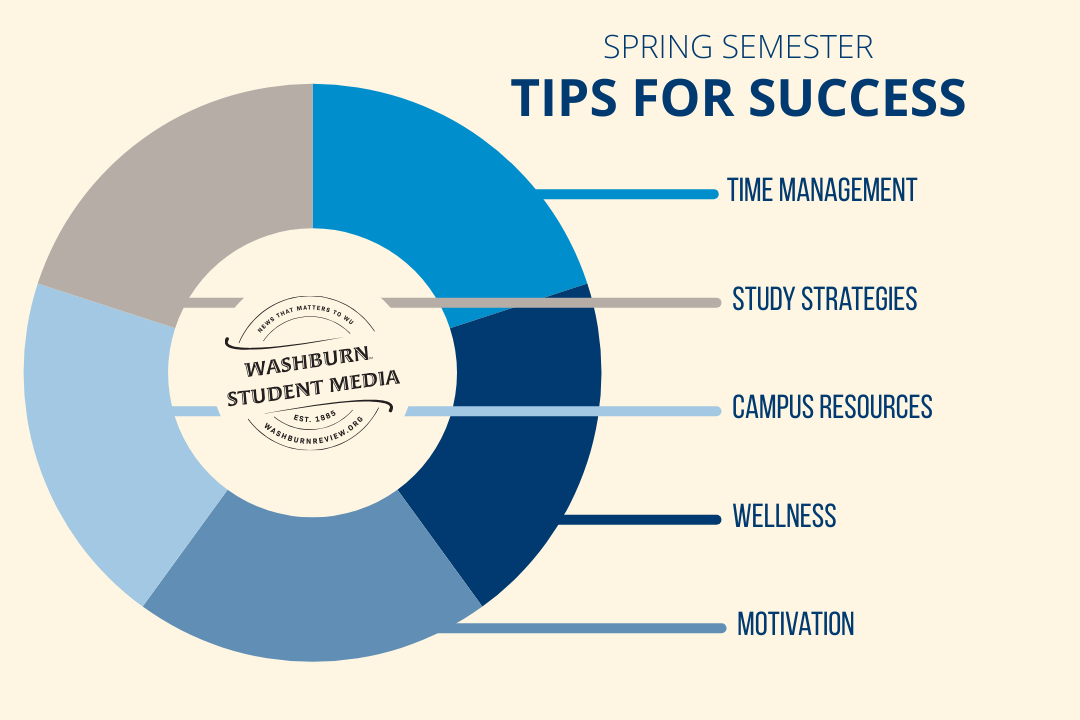
Tip #1 – Time Management
Each semester, students start fresh, some plan their days to the minute, while others have a schedule that flows more freely. Both options have their pros and cons for students. More rigid schedules allow for detailed planning so no stone goes unturned, while looser planning allows for more flexibility.
To best manage your time, it is recommended to use a planner or a calendar app to mark out important dates and schedule time to study throughout the day.
“Every class is going to give you a syllabus and that syllabus is likely going to have a schedule. Put your due dates in your calendar, set reminders and stay on task. That’s the biggest thing because you’ve got to make sure things are turned in. Can’t grade what’s not there,” said Franki Ostrom, instructional librarian who teaches WU101 and information literacy.
University guidelines recommend spending two hours outside of class for every one hour in class, for a full time student, this adds up to 24 hours spent outside of the classroom total. While not all classes require this amount of work, it is good practice to set aside time to specifically spend on each class outside of the classroom for homework, studying and meeting with professors.
“I know that it’s easy for me to say that every student should spend two hours outside of the classroom for every hour they spend in,” said Sean Bird, dean of University Libraries and Center for Student Success. “That’s hard, that’s a challenge and some classes don’t demand that, but when we start allowing ourselves to negotiate with ourselves about how we use our time, I think that it might become clear that we have a little bit more to give.”
Tip #2 – Study Strategies
One of the main points of college is that students come to learn and grow as people and in their areas of interest. Washburn faculty had plenty of advice on how to succeed in your classes as well as outside of your classes.
“Come to class, attendance is so important, truly, in-person classes, what makes them so great is the interactions that you have with your professor, as well as your peers,” said Breanna Gellings, English lecturer.
With AI being a hot topic on many college campuses, take your time with your work and always try to learn as much as you can without relying on large language models to do the work for you. AI has many great potentials, but it can also have great negative impacts on your learning.
“Don’t let AIs think for you,” said Justin Moss, philosophy and religious studies professor.
If you have concerns on how to use AI ethically, ask your professors for their AI policies and if you ever think, “Is it okay to use AI on this?” take a step back and ask. Many professors would rather you be honest than try to hide AI use and learn less than if you do the work without AI. Be transparent.
Kosman Rajapaksha, mathematics and statistics assistant professor, said that students should follow through with lectures and stay on top of homework as soon as the chapter is over.
Bird also said that the number one thing for students to recognize is that school requires attention, whether that attention is reading assigned readings or learning how to understand the human experience more fully.
Give your classes the attention they deserve by spending time to understand the topics and not just speed through them. If you get stuck, ask your professor for help instead of waiting until the last moment to get assistance.
“I found some people do not know how to study for language and so they eventually ask for help too late during the semester,” said Helene Perriguey-Keene, French and Spanish lecturer.
Don’t be afraid to ask for help from your professors, it’s their job to help you succeed in their class.
Tip #3 – Campus Resources
Getting the support you need on campus doesn’t have to be scary, it can be as simple as setting up an appointment in Navigate or talking to a professor you trust.
Some campus supports include: the Center for Student Success and Retention (CSSR), Counseling Services, Accommodations, Bods Feeding Bods (BFB), librarians, academic advisors and professors.
If you are struggling in class, the best advice is to ask for help. Visit your professors during their office hours and tell them you are struggling.
“I think it would absolutely benefit students to go to student hours, because it’s where you have time to get one on one attention from your instructors,” Ostrom said. “That’s not something that you can get a lot in other places in your life. You have a chance to sit down and just ask all the questions that you need to ask to the person who has all the answers.”
If you need help in multiple classes, the CSSR is located in Plass Learning Resources Center and would love to help you catch up.
“There are academic advisors here, there are academic coaches here, we are connected to the opportunity for students to get support, either through tutoring or through the math lab, for example, because we want to be able to provide those students with the tools that they need to be successful,” Bird said. “We can’t fix what is outside of our control, but that stuff that’s inside of our control sometimes we don’t know where to start, and the CSSR gives students that connection.”
There are also plenty of resources for other needs on campus such as food insecurity or mental health concerns, where people are happy to help.
The BFB food pantry is located on the first floor of Kuehne Hall and available to all students, faculty and staff. Counseling services is also located in Kuehne on the second floor and has trained professionals that can help you navigate day to day life and mental health crises.
Tip #4 – Wellness
Taking care of yourself is a long journey that doesn’t have to be hard. Each semester is a fresh start and gives plenty of time to build a self-care strategy.
There are many easy steps you can start now to take better care of your mind and body. Starting the day with affirmations to keep your mind healthy, taking walks or visiting the recreation and wellness center during long breaks, read books to develop your writing skills, eat more filling meals with plenty of nutrients and don’t overwork yourself.
“Work to stay healthy and to manage your calendar in terms of not taking on too much, give yourself time for fun and things like that, but if you take on too many amazing opportunities, you end up getting pretty tired and pretty burnt out, and don’t always get to be successful at all of the things then,” Lambing said.
Tip #5 – Motivation
Motivation plays a key role in succeeding each semester. If you lack motivation, try to find out why. For some students, they might not be in a major they’re passionate about, maybe they struggle to keep up with in-class discussions or perhaps the class isn’t the best fit.
When students hit the same obstacles over again, it creates a doom loop where success begins to feel further and further away. Address these obstacles to grow past them. Learning to cope with these issues can help solve even more obstacles down the road.
Mental health matters and learning strategies to push forward is a responsibility you have to yourself. No one can push through these barriers for you.
Take care of yourself and ask for help when you need it. There are people on campus who care about you and want you to succeed.
Edited by Anushma Dahal and Bidhya Sapkota