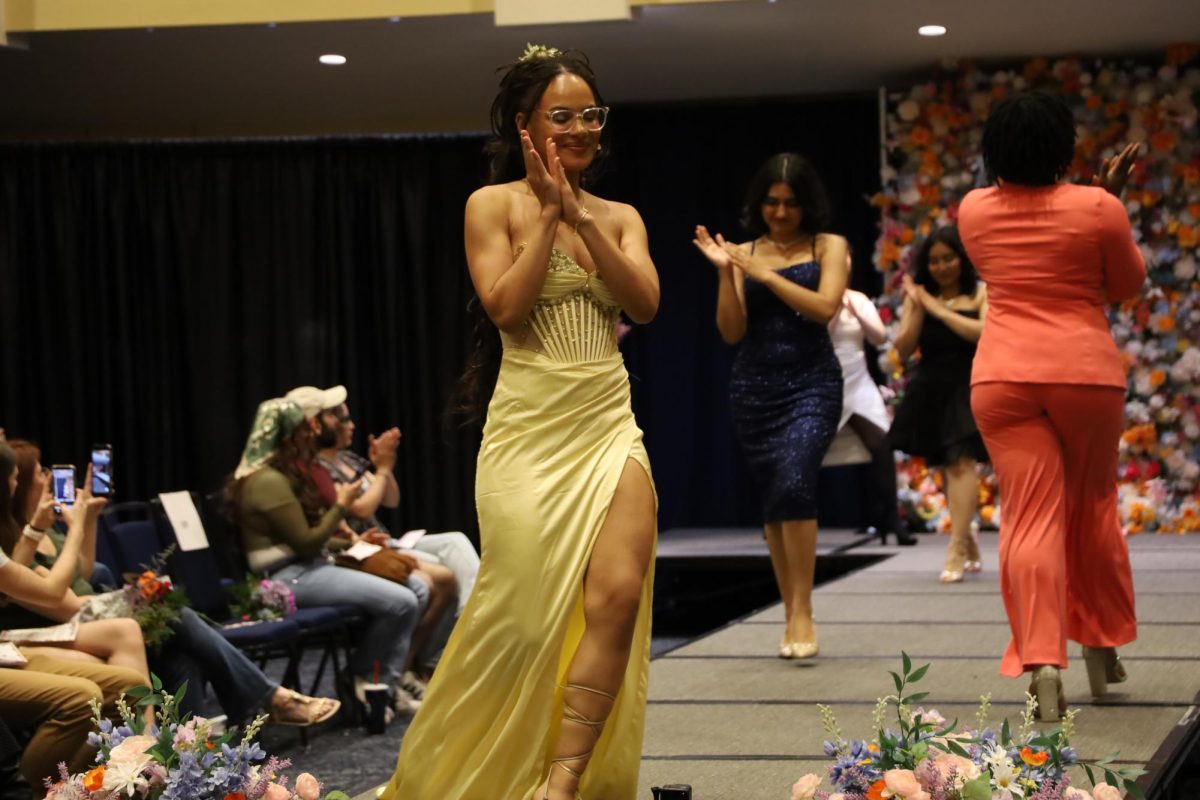
On Friday, April 17, Apeiron will take place at a different reception venue in Washburn from 9:30 a.m. Apeiron includes a keynote speech and sessions for oral presentations, poster presentations and performing arts. During the oral session, several presentations happen at the same time. In the poster session, all the posters are displayed for viewing. Fine Arts presentations usually involve performances or other types of artistic work.
It is the main event where students can present the work they’ve been working on which is similar to an academic conference. Each year, a retired Washburn professor gives a lecture and this year, there will be a lecture by Sharon Sullivan, former professor and longtime department chair of theatre.
“Washburn students are amazing and do all sorts of wonderful things. Every time I go to Apeiron, I learn a ton of new things and I learn more about how awesome Washburn students are,” said Jennifer Wagner, interim chair of Apeiron committee. “To do the project, they learn a lot of things about perseverance and doing a long project for presenting, they learn a lot of communication skills. Whichever form of presentation they give they’re communicating their excitement and their ideas with the world and it’s a great experience and it’s a very supportive setting.”
Wagner talked about how it started as a place for students to share the projects they had worked on and that purpose has remained the same. At the beginning, it only included poster presentations and was mostly for science students. Over time, it has grown to include students from across the whole university, with many different ways for them to present what they have done and learned.
Students share their findings, expectations and research. Kristi Edelman, senior nursing major, talks about her poster presentation and the results she discovered during her research.
“The research that I found was the most startling regarding patient education and the lack thereof typically in hospitals today,” Edelman said. “[…] The nurse’s role is to evaluate a patient’s understanding of what they need to be doing when they get home. One of the things that my project that I learned is that the teach back method of patient education is the most effective. […] Nurses, slow down and take time to educate your patients.”
Edelman explained that stem cell transplants are becoming more common in cancer treatment. The process involves collecting stem cells from the patient, giving very high doses of chemotherapy to destroy cancer in the bone marrow and then returning the stem cells to help the body recover.
Grace Wright, senior biology major, talks about her poster presentation and the findings.
“I like microbiology with all the plating and doing stuff with bacteria. So, I figured it’d be really interesting. We wanted to figure out what kind of probiotics and stuff are in kombucha, that’s where they looked,” Wright said. It’s definitely interesting to see what we’re putting in our bodies. To me, it’s interesting to see what we’re actually drinking and to identify the types of bacteria. We have a lot of pictures. We’re very visual. And my partner in the research, she wants to make kombucha for people to try.”
Wright explained that they use bead beating to break open bacterial cells and collect DNA, then amplify it with PCR and run it on a gel for identification. They found that a long process damages the DNA, so they are now trying shorter times to get accurate results.
Amy White, director of the stimulation school of nursing, highlights the role of health literacy in managing diabetes.
“Health literacy consists of a bunch of different things, sometimes it can be just vocabulary, sometimes it’s reading ability and other times it’s access to resources,” White said. “We teach nurses to speak medical but it’s also important to know how to translate that to patients. Nursing is an art and a science and having the skill of being able to put research into a poster form and then share it with your colleagues.”
White talked about the health problems that can happen with diabetes. It can affect blood circulation and nerves, causing pain, numbness and skin problems like ulcers. Diabetes can also lead to heart issues. For pregnant women, uncontrolled diabetes can cause high blood pressure, preeclampsia and risks to the baby, including heart defects. She emphasized that educating patients about managing blood sugar is very important to prevent these complications.
Rebecca McCreight, senior chemistry major, talks about finding safer and cost effective solvent alternatives to replace dichloromethane in chemical reactions.
“I’ve been trying to find an alternative solvent to complete a ring closing metathesis which is basically like a chain of like atoms together, I’m trying to make it into a circle. […] Macro cycles are used a lot in stabilizing things in MRIs,” McCreight said. There’s a lot of medical chemistry aspects as well as material science aspects as macro cycles are being used for. I think I’m most excited just to show the results and share it with people, so that way they can see how it’s progressing. I definitely have some options that could potentially be there and then there’s definitely been some results that I’ve not expected. But I’m really excited to see more of how it works.”
McCreight is working on testing different solvents to see which gives the highest conversion rate. So far, one Ether shows the highest conversion but she has also tried a non-polar solvent. The results are still in progress and she plans to test further using nuclear magnetic resonance once the experiment is complete.
Apeiron gives Washburn students a chance to share the work they have put time and effort into. From research projects to art and performances, it shows the different ways students learn and express their ideas. As the event continues to grow, it remains a meaningful space where students can present their work and connect with others in a supportive setting.
Edited by Anushma Dahal and Bidhya Sapkota