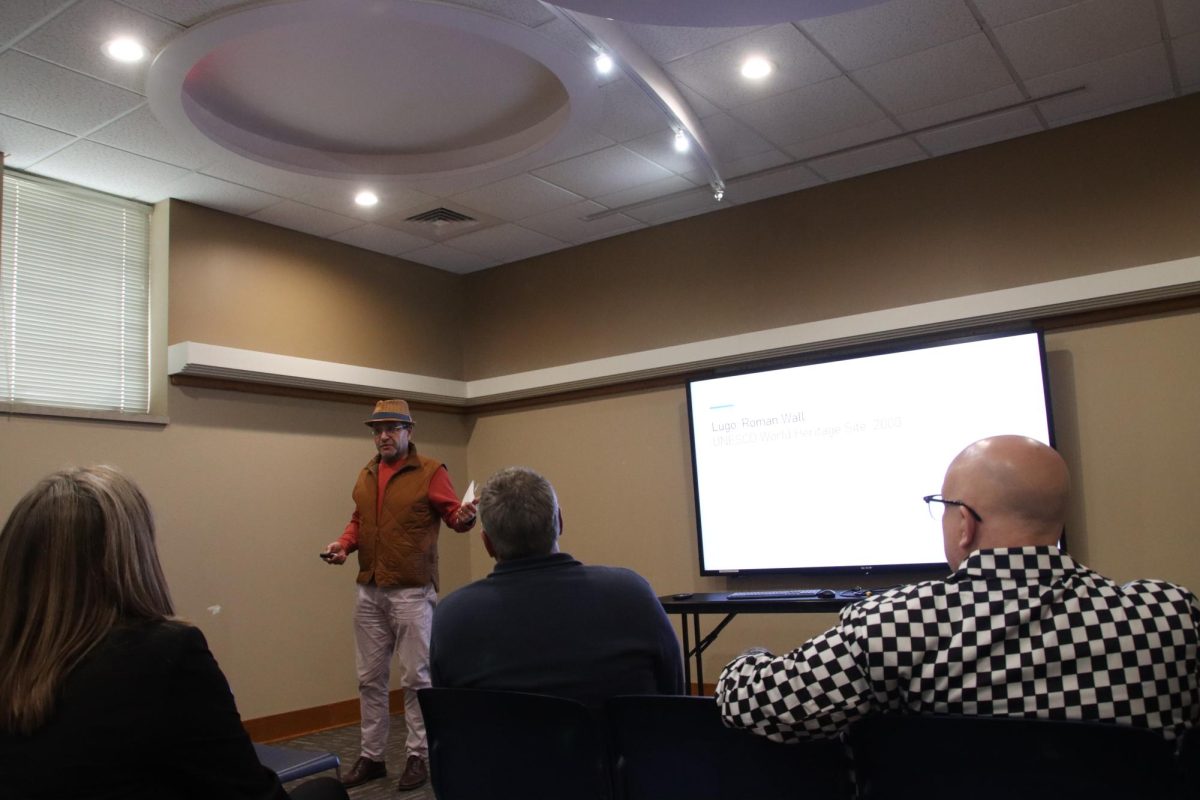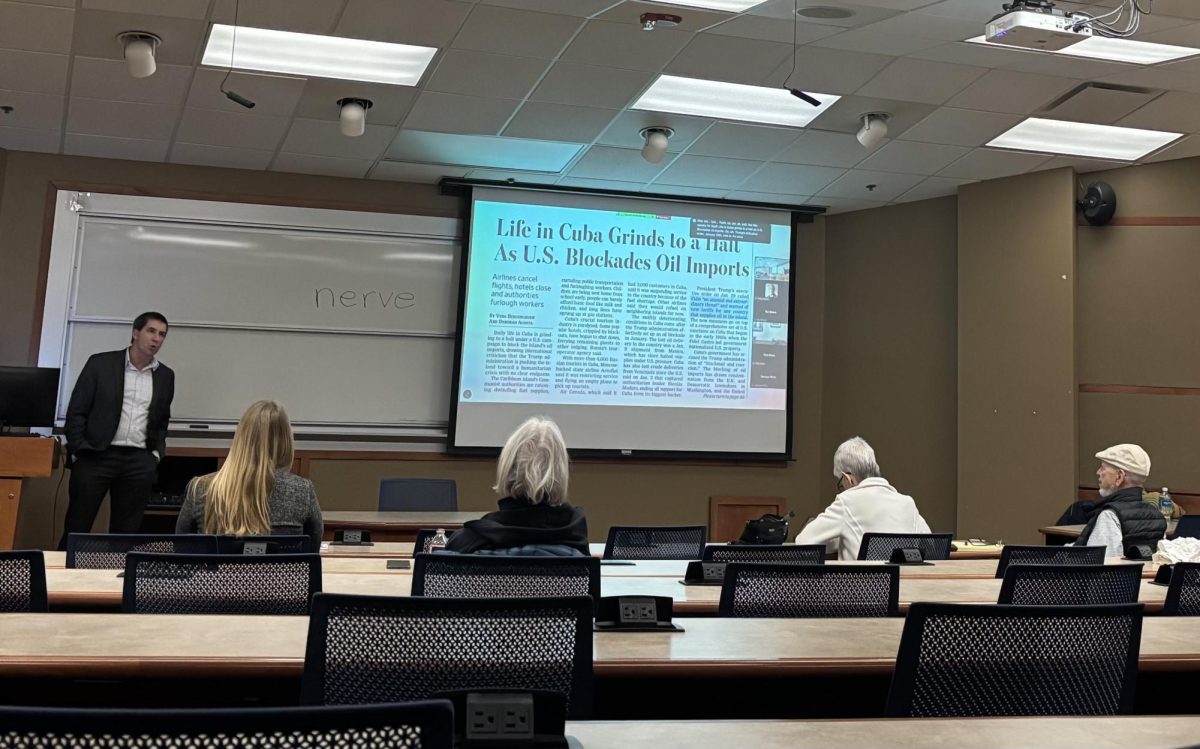
On Thursday, Feb. 12, students filled Plass 120 for a forum on U.S. intervention in Venezuela and what has happened since. The event brought together Washburn University professors from several departments to break down the issue. The in-person audience consisted mostly of Washburn’s senior audit students, while many others joined in through Zoom as well.
The panel featured Kim Morse, professor of history, Dmitri Nizovtsev, professor of economics, Craig Martin, professor of law and Linsey Moddelmog, professor of political science. Together, they explored what led to the intervention, what it means for Venezuela and how it affects the U.S. and the rest of the world.
Morse opened the forum by walking the audience through Venezuela’s long reliance on oil and the political conflicts tied to controlling it. She explained how nationalization under Hugo Chávez changed relationships with foreign companies and the U.S., and how years of economic decline, political repression and sanctions pushed Venezuela closer to countries such as China, Russia and Cuba.
Nizovtsev explained the economic reality behind Venezuela’s massive oil reserves. He said that while the country holds the largest verified reserves in the world, much of it is heavy oil that is costly and difficult to produce. That, he explained, limits how much Venezuela can influence global oil prices.
Martin then discussed the international laws pertaining to the intervention and questioned whether recent U.S. actions are legal under existing rules. He explained about the U.N. Charter, stating it only allows the use of force in self-defense after an armed attack or with approval from the U.N. Security Council.
Martin said smuggling drugs does not constitute an armed attack under international law. Martin also pushed back against the idea that the situation should be treated as an armed conflict.
“One cannot just assert that there is an armed conflict and bring it into being,” Martin said.
Martin added that international human rights law still applies when countries use force outside their borders. He also said that the European Court of Human Rights has held that when a state is killing people, that’s an exercise of jurisdiction.
Moddelmog closed the forum by placing the intervention in the bigger picture of U.S. foreign policy under President Donald Trump.
Moddelmog argued that recent actions show a more unilateral approach and echoes an old Monroe Doctrine style view of the western hemisphere.
“He [Trump] is not even pretending, like when presidents normally pretend it’s not about the oil, it is about democracy. No, he just says it’s about oil,” Moddelmog said.
The forum ended with a question and answer session, where the audience participated through a number of questions and their thoughts on the issue. The discussion reflected both hope for change and concern about what the intervention could mean in the long run.
Edited by Arohi Rai and Stuti Khadka