


It takes a special kind of audacity to tell someone that their time is valuable, their skills matter and their future is important, right before explaining that none of this is worth a paycheck yet. Unpaid internships have become a normalized feature in early career development, often presented as a stepping stone into competitive industries.
Internships are marketed as opportunities for students to gain experience, build professional networks and improve their “employability.” However, beneath this optimistic framing lies a more troubling reality: many unpaid internships function less as educational experiences and more as a modern form of labor exploitation. While not all unpaid internships are inherently unethical, the widespread reliance on unpaid labor raises serious economic, social and moral concerns.
At the center of this issue is a basic principle: work that creates value should be compensated. In many contemporary internships, students are not merely observing or training; they are constantly performing tasks. Interns answer emails, manage data, create content, conduct research and support daily operations, all responsibilities which, in other contexts, would be assigned to paid employees. Calling this “just a learning experience” does not change the fact that the organization benefits from it.
Supporters of unpaid internships often argue, “but it’s an investment in your future. It doesn’t always have to be about money.” While experience is undoubtedly valuable, this argument assumes that all students can afford to work without pay. Common sense says it disproportionately benefits those with financial support and personal savings. It is difficult to reconcile the rhetoric of “opportunity” with the reality that basic living costs do not pause for professional development. Rent, food, transportation and tuition cannot be paid with experience alone. This ultimately results in a system of inequality, where wealthier students have stronger résumés and professional connections, while others are left behind, despite equal or greater ability.
In the United States, federal labor law doesn’t automatically exempt internships from compensation. Under the Fair Labor Standards Act, the U.S. Department of Labor uses a “primary beneficiary” test to assess whether an intern is, in fact, an employee under the law. If the employer, not the intern, benefits more from this relationship, then the intern is entitled to wage protections under FLSA.
I’m not ready to label all unpaid internships as evil. Those that are short-term, truly educational, mostly observation-based and do not replace a real job can add value to a student’s education. If a student has clear learning goals by shadowing a professional for a limited amount of time, that makes sense. But more often, companies slap the word “intern” on a role that looks suspiciously like “junior employee” and call it a day. If you have deadlines, responsibilities and deliverables that matter to the business, it is not just learning. It’s working — as simple as that.
The emotional manipulation is the most troubling part. I’ve heard that those who criticize unpaid positions don’t understand “how the world works.” This framing discourages legitimate concerns and encourages silent acceptance. That’s a great disservice to students. You are teaching them early to undervalue their own time and to treat personal boundaries as negotiable.
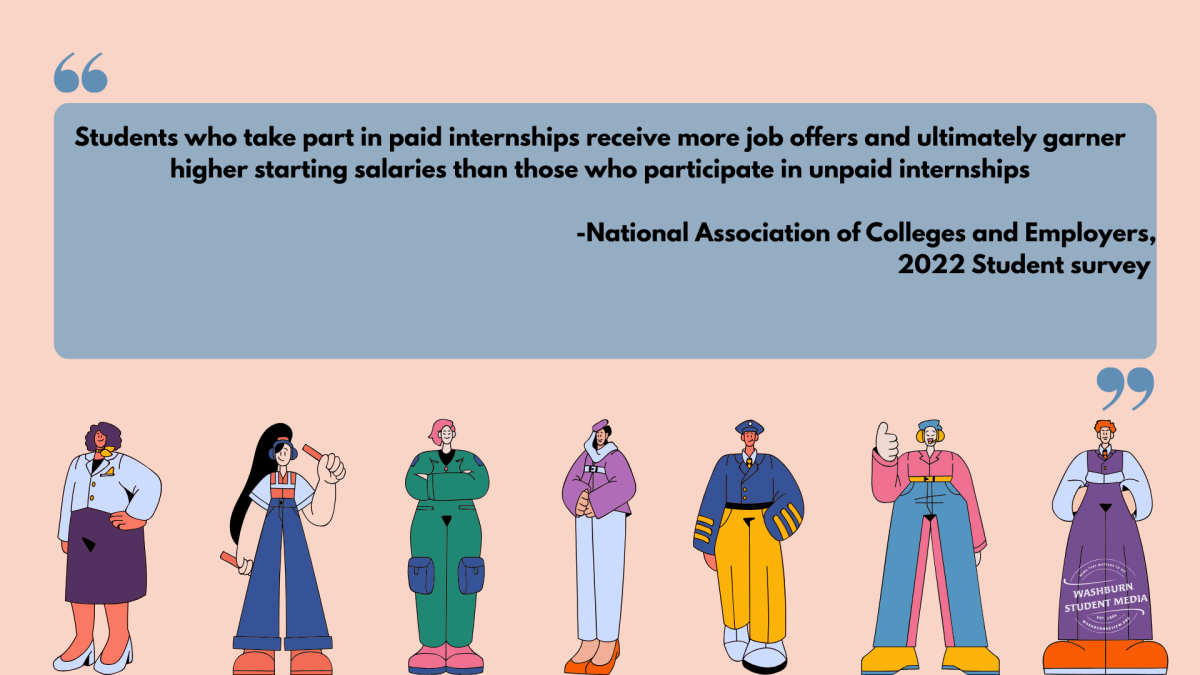
I’m not saying learning on the job isn’t valuable. It most definitely is. I’m saying learning and working are not mutually exclusive with getting paid. All three can be done at the same time. In fact, research conducted by the National Association of Colleges and Employers shows that students with paid internships earn considerably higher-paying jobs out of college than those who complete unpaid internships.
Edited by Anushma Dahal and Bidhya Sapkota










Tim Peterson • Feb 19, 2026 at 1:55 pm
Great article! Coincidentally, this month is the fifth anniversary of the Kansas Micro-Internships (KMI) program offered by the Kansas Board of Regents through which students enrolled at any of the 32 Kansas public colleges and students can apply for short-term paid professional projects offered all year around. Let me know if you’d like more information about this innovative work-based learning program.