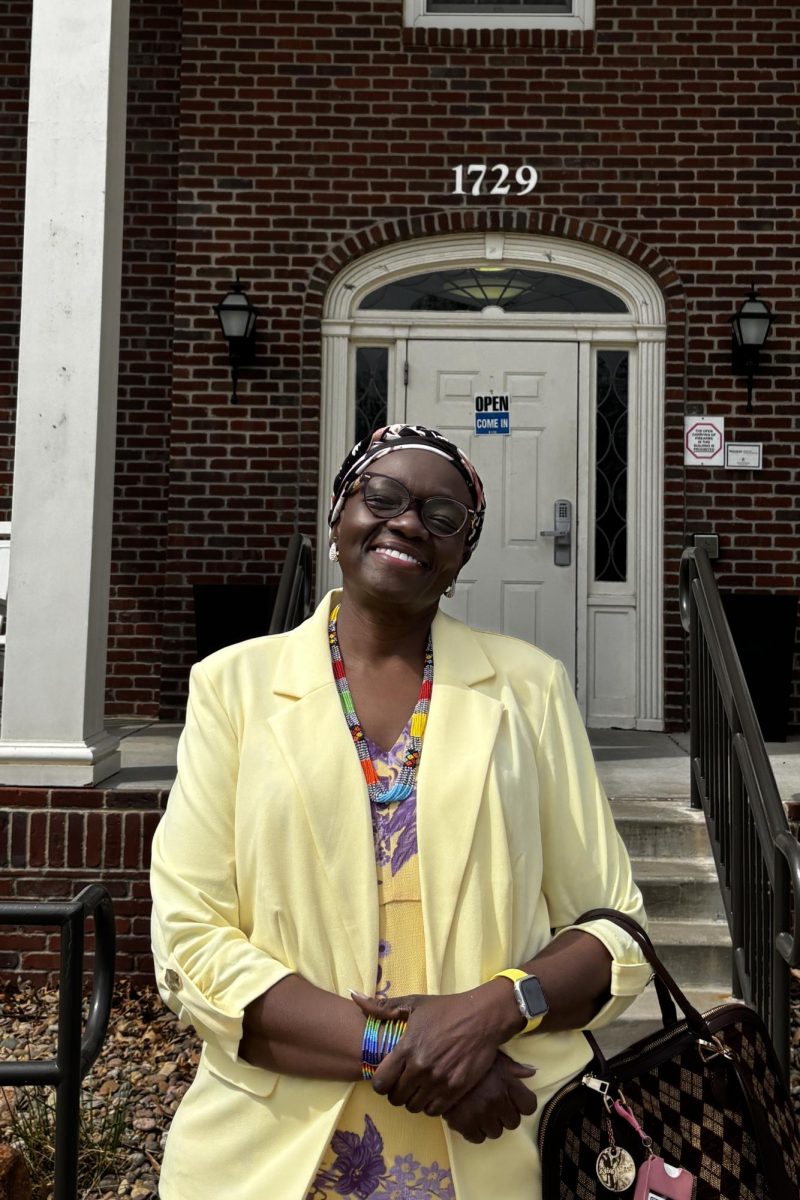
Cynthia Maxwell, English lecturer, has spent her life moving through the rhythm of university towns, curiosity in her eyes and a typewriter close at hand. From Oklahoma to Texas, Louisiana and North Carolina, she grew up surrounded by books, classrooms and the energy of academic life, a backdrop that would shape her passion for teaching, storytelling and lifelong learning.
“My uncle was a lover of books and I grew up in a home with books everywhere,” Maxwell said. “I thought when I was six years old that I wanted to be a writer.”
To nurture her early love of storytelling, her uncle gave her a real typewriter, sparking a lifelong fascination with words and ideas.
Maxwell also comes from a lineage of educators. She is the fourth generation of women in her family to teach language, following her mother, grandmother and great-grandmother. Her heritage, combined with her early literary influences, shaped both her educational and professional paths.
Maxwell earned a double major in history and English at Midwestern State University in Wichita Falls, Texas and a master’s degree in English from Wichita State University. Maxwell later completed doctoral coursework in Baton Rouge, Louisiana, before leaving to teach World Studies at Austin High School in 1999. She returned to Wichita State to earn an MFA in creative writing in 2011, balancing her professional ambitions with family life.
Maxwell’s teaching journey has been far from conventional. She spent two years in the Peace Corps in Thailand teaching English as a second language, relishing the food, culture and landscapes she encountered. She also studied abroad in Germany and worked for the State Board for Educator Certification in Texas.
“Teaching has always been integral to my identity,” Maxwell said. “I see myself first as a student and then as a teacher, because you can’t teach something without being a student of it.”
Maxwell’s path eventually brought her to Washburn University, encouraged by friends in Topeka who saw her values aligning with the school’s mission. Maxwell now teaches EN 101, EN 103 and EN 300, using a Socratic style that encourages students to think critically, develop their own voices and build confidence in communication.
“The thing I hope my students take away from my classes is confidence; confidence in writing, in speaking and in themselves,” Maxwell said.
Mousam Bhandari, senior computer information sciences and data analytics major, describes Maxwell as a genuinely supportive and caring educator. He especially values her approach to assignments and projects, noting that she provides thoughtful feedback before assigning grades. This method allows students time to review her comments, make improvements and achieve their best possible results.
While Bhandari finds some assignment instructions occasionally unclear, he appreciates that Maxwell prioritizes student growth and learning, giving them the chance to correct mistakes and succeed overall.
“The only part I personally struggle with is the clarity of our instruction. I’m not sure if it’s just my experience or if other students feel the same way, but sometimes the directions or assignments or expectations can be a little unclear. I usually try to read them a few times or check with classmates to make sure I’m understanding everything correctly,” Bhandari said. “But you know, despite that, I still appreciate her overall approach because she gives us the opportunity to fix our mistakes and succeed well overall. I think she is a supportive professor who truly wants her students to do well, even if there are a few areas where communication could be a bit unclear.”
Maxwell has never owned a car of choice shaped by childhood experiences on dirt roads and concern for the environment; instead, she rides a bike.
“I have never had a driver’s license,” Maxwell said. “I saw a lot of wrecks growing up on a dirt road and as I got older, I realized the negative impact cars have on the environment. So, I just ride my bike.”
Her classroom blends modeling and experimentation. Maxwell frequently explores new tools like artificial intelligence, testing prompts to see how emerging technologies can enhance communication, particularly for English language learners.
“I’m interested in AI,” Maxwell said. “It’s exciting, but it also makes what I do feel less important. At the same time, it helps students communicate more effectively.”
Remington Beard-Alvarado, a junior majoring in psychology, reflected on Maxwell’s teaching. While the class was initially challenging due to a lack of detailed rubrics, it encouraged independent thinking and application of prior experience.
“But overall, I’ve enjoyed the assignments. I would say, I think they’re very helpful in things regarding my professional life… Looking into possible jobs that I might want to go into, just really nailing all that information down was very beneficial for me,” Alvarado said. “[Maxwell is] very supportive and very excited to help… she definitely wants students to succeed and is very willing to help out whenever she can.”
Outside the classroom, Maxwell contributes to the Washburn community through the College of Arts and Sciences Faculty Success Group and Student Engagement and Opportunities initiatives. She also volunteers locally with organizations such as Doorstep and Harvesters, assisting those facing food and housing insecurity.
In her personal life, Maxwell is equally hands-on. She gardens in spring, summer and fall, often working in her mother’s garden and at her church. The hobby has given her a mild allergy a small price to pay for spending time outdoors. She also enjoys film and television, praising the adaptation of Margaret Atwood’s. The Handmaid’s Tale for its cultural depth and timely themes of environmental and societal challenges.
“I love watching students develop their ideas, just like I did as a child with my typewriter,” Maxwell said. “Learning never stops, whether it’s in the garden, the classroom or through new technologies like AI.”
For students pursuing English or related fields, Maxwell advises openness and adaptability.
“An English degree can pretty much take you into almost any field,” Maxwell said. “It means you’re an effective communicator and that’s valuable everywhere.”
From a childhood spent imagining stories on a typewriter to classrooms filled with curious students, Maxwell embodies a life devoted to learning, teaching and inspiring others, proving that the best journeys often begin in the heart of a university town.
Edited by Anushma Dahal and Arohi Rai