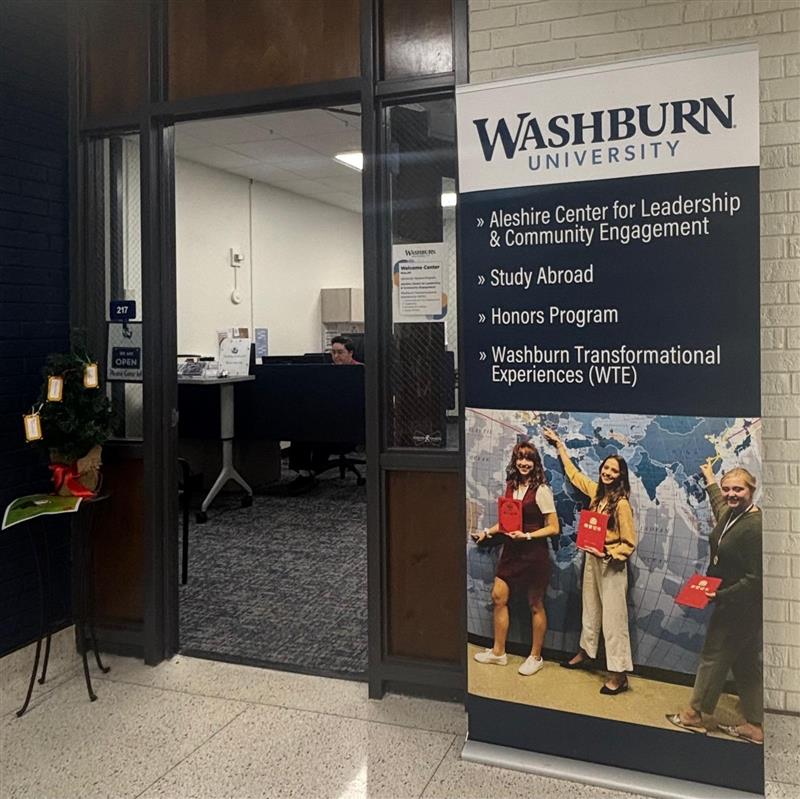
Tucked inside Washburn’s Leadership & Community Engagement hub, the Aleshire Center has become one of the university’s most intentional spaces for shaping students into thoughtful, socially engaged leaders. Although the center is a recent addition by name, it represents decades of campus history.
Washburn’s Leadership Institute and Learning in the Community (LinC) once operated on parallel tracks: one rooted in leadership education, the other in civic engagement, before merging in 2024 with support from Joe and Janet Aleshire. The result was a unified home for high-impact leadership and community-based learning under one roof.
The center’s mission emphasizes developing global citizens, building strong community partnerships and helping students understand leadership as something they practice rather than something they perform. Academic programs like the Leadership Studies and Community Studies minors provide a foundation, but much of the center’s daily life comes from its three co-curricular programs: the Bonner Leaders, Leaders of Tomorrow (LOT) and the Washburn Leadership Challenge Event. Together, these programs allow students to blend service, skill-building and personal growth in ways tailored to their strengths.
Among these initiatives, the Bonner Leaders program stands out for its depth and structure. Bonner is a national model that requires partner campuses, including Washburn, to meet certain eligibility standards. At least 75% of Bonner participants must be Federal Work-Study eligible, Pell-eligible or meet low-income criteria.
Students commit to long-term, multi-year community service, typically completing around 1,000 hours by graduation, making the program especially accessible to first-year and sophomore students. Before fully committing, students can complete a “pre-Bonner” semester that lets them experience the rhythm of the program while earning credit toward Washburn’s Community and Civic Engagement Transformational experience.
Bonner Leaders at Washburn commit to long-term, community-based service that becomes a defining part of their college experience. Students work closely with local organizations across Topeka, often in roles tied directly to their academic interests.
“Bonner leaders focus on deep community service, completing around 1,000 hours at sites that often connect to their majors. One student I know is already at about 1,400 hours,” said Jaxon Blubaugh, Washburn Leadership Challenge fellow.
The program’s structure allows students not only to support community partners but also build practical skills and relationships that carry into their future careers.
Madeline Lambing, associate director of leadership experiences and lecturer at the Aleshire Center, described Bonner’s impact as deeply individualized.
“No two stories are the same. We’re not trying to create one type of leader. We want students to figure out what feels natural and authentic to them,” Lambing said.
The Aleshire Center’s focus on authentic, community-minded leadership resonates deeply with many of its students. Karly Neufeld, sponsorship and awards coordinator, said the program has helped her redefine what leadership truly means. Rather than viewing it as a matter of authority or title, she now sees it as a responsibility to uplift others.
“Leadership for me is inspiring and serving others,” Neufeld said.
Neufeld noted that the center has shown her how simple, everyday actions such as supporting a peer, volunteering at an event or simply being present can meaningfully strengthen the campus community. Lambing also explained that students learn by understanding the context of the organizations they work with.
“Every student gets to have so much growth […] especially their confidence,” Lambing said. “They know that they can walk into any organization and make sense of the organization like quickly read what’s going on, the dynamics and then think about how they become influential that is authentic to them, not putting on a mask or shape shifting or trying to be somebody that you are not.”
Bonner’s influence extends far beyond hours logged. Over the years, several Bonner students have developed significant service projects that grew into lasting campus and community initiatives, including the student-founded Bods Feeding Bods pantry. The pantry has grown into a multi-campus resource, offering meals, hygiene supplies and pantry staples to students facing difficult financial circumstances. Other capstones have supported animal welfare groups like Team Kitten, expanded volunteer systems across local nonprofits and assisted health-care access initiatives in partnership with Stormont Vail.
Bonner students also navigate the realities of community partnerships: weekly service shifts, communication with site supervisors, issue-based reflection and structured learning commitments that connect service to larger social issues. Over time, this creates an ecosystem of trust between Washburn and Shawnee County organizations. Lambing noted how powerful this network becomes.
“Service becomes a space where students understand who they are, what communities they belong to and how they want to show up. That’s the kind of leadership that lasts,” Lambing said.
While Bonner develops leadership through depth, the LOT program builds it through variety, accessibility and steady involvement. LOT offers students a wide slate of workshops, cultural dialogues, student-led socials, advocacy sessions and Service Saturdays that run throughout the semester, allowing students to engage as much or as little as their schedules allow.
For many, it becomes the natural doorway into the Aleshire Center. The programming shifts constantly; one week might include a mocktail social or an international discussion, while another features a football tailgate, a mentorship night or a hands-on service project. Each event gives students a low-pressure space to meet new people, try something unfamiliar and gradually build the confidence that leadership often requires.
Cara Brockmeyer, Aleshire student employee, explained that mixing leadership development with community engagement is essential because both require an understanding of how to get involved and how to make a positive impact. She said leadership is about learning to meet people’s needs and recognizing the different opportunities available within the community. She cited one of the center’s main sponsors, Joe Aleshire.
“You can’t be a great leader without being involved in your community,” Brockmeyer said.
Brockmeyer added that combining leadership and service is the most effective way for students to truly learn what leadership looks like in practice.
The third major program, the Washburn Leadership Challenge Event, transforms the Center’s philosophy into a large-scale experience. Every year, high school and college teams spend two days on campus navigating a fast-moving leadership simulation. Participants respond to ethical dilemmas, manage crises, collaborate under pressure and communicate through ambiguous, shifting scenarios. Though the event itself is brief, planning it requires months of preparation, giving student coordinators hands-on experience in event logistics, partnership development and leadership facilitation.
Together, the three programs create a leadership ecosystem defined by experience, reflection and community connection. Students often describe the Aleshire Center as a place that becomes part of their daily rhythm, not just because of events, but because the environment feels collaborative, relational and grounded. The Center becomes a hub where students study, volunteer, meet with faculty, plan events or simply sit and talk through ideas. According to Lambing, that sense of belonging is not accidental.
“Students spend time here because it feels like a space where they belong. Community is part of leadership, who you surround yourself with and how you grow together matters,” Lambing said.
Lambing added that the merger between leadership and civic-engagement units strengthened that environment.
“Leadership without community engagement isn’t complete, and community engagement without leadership doesn’t create personal growth. The merger brought those two halves together in a way that finally makes sense,” Lambing said.
Students who pass through the Aleshire Center leave with more confidence, more awareness and a clearer sense of responsibility to the places they inhabit. Lambing mentioned that transformation is at the heart of why the center exists.
“Every student grows at their own pace–some slowly, some suddenly, some in unexpected ways. But they all grow. And what they learn here stays with them long after they leave Washburn,” Lambing said.
The Aleshire Center may still be new, but its reach is already expanding across campus and beyond. It unites service, involvement and practical experience, showing students what leadership looks like when it’s lived rather than talked about. And at Washburn, that kind of leadership continues to build.
Edited by Anson Appelhanz and Arohi Rai and Stuti Khadka