


Every Jan. 29, Kansans celebrate the state’s birthday, but Kansas Day is more than a yearly shout-out to statehood. It is a tradition rooted in education, shaped by community pride and still evolving as a way to understand what Kansas has been and what it continues to be. This year, Kansas marks its 165th birthday, a milestone that highlights how long the tradition and the conversations it encourages, has endured.
Kansas Day began in 1877 in a Paola public school classroom. A teacher named Alexander LeGrande Copley noticed that students connected more deeply with history when it was tied to meaningful anniversaries. After teaching a lesson on the Battle of New Orleans, he set aside Jan. 29, the anniversary of Kansas’ admission to the Union, as a day dedicated entirely to the state.
Students researched Kansas geography, history and resources, covered blackboards with maps and state symbols, recited poetry and delivered speeches on Kansas “firsts.” The celebration drew so much interest that parents and community members crowded the school, with many unable to fit inside the classroom.
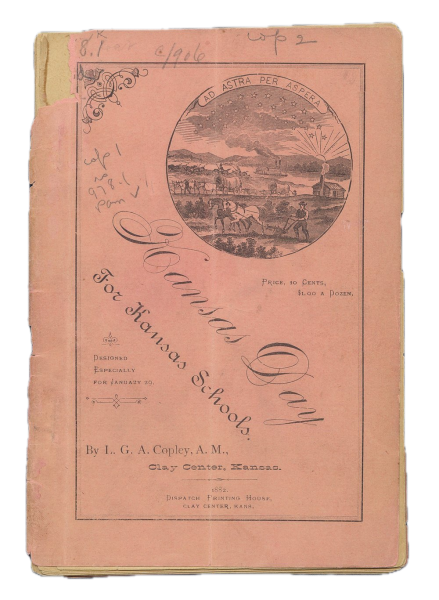
What started as a single lesson quickly spread. When Copley later became superintendent of schools in Wichita, he promoted Kansas Day across the state. By 1882, a pamphlet titled “Kansas Day for Kansas Schools” was distributed statewide, providing teachers with lessons, songs, poems and historical information. That publication marked the beginning of the statewide Kansas Day celebrations still familiar today.
For Kerry Wynn, director of the Honors Program and professor of history at Washburn University, Kansas Day matters because it creates an opportunity to talk about history in the present. Rather than treating history as something distant or finished, Kansas Day invites reflection on how the past continues to shape life in the state today.
Kansas history, Wynn explains, is often underestimated.
“Kansas is a lot more interesting than people give it credit for,” Wynn said. “Kansas has been more radical than the rest of the country.One of my colleague says, and this comes from someone else originally, that Kansas is like an indicator of where the nation is going…Kansas is very often an early adapter of things like the amendment that granted women the right to vote and the Equal Rights Amendment.”
One story Wynn believes deserves far more attention is Kansas’ Indigenous history. When Kansas became a U.S. territory in 1854, there was not a single acre of land available for public sale. All land belonged to Indigenous nations and the federal government had not yet surveyed it. Kansas Day itself emerged in the 1870s, during a period when land ownership and settlement were still deeply contested. Yet Indigenous presence, both historically and today, is often overlooked in Kansas Day celebrations.
While Kansas Day began in classrooms, it has expanded far beyond them. Today, the Kansas Historical Society coordinates statewide educational programming that includes museum events, classroom resources and virtual field trips. This year, Kansas will celebrate its birthday with in-person events at the Kansas Museum of History, hands-on activities, live performances and virtual presentations accessible to students across the state. These efforts show that Kansas Day remains an active, evolving tradition rather than a historical relic.
Public libraries also play a major role in keeping Kansas Day relevant. According to the Johnson County Library, modern celebrations highlight not only history but also culture, trivia and everyday connections Kansans share with their state. From Bleeding Kansas and state symbols to pop-culture moments like Pizza Hut’s founding in Wichita or the invention of the ICEE in Coffeyville, Kansas Day offers something for everyone.
Kansas’ influence extends far beyond its borders through notable figures tied to the state. According to the Johnson County Library, leaders like Dwight D. Eisenhower, pioneers like Amelia Earhart, civil rights figures such as Linda Brown, artists like Gordon Parks and innovators like Jack Kilby all have Kansas connections. Their stories reinforce the idea that Kansas has played a meaningful role in shaping national history, culture and technology.
Despite this rich past, Kansas Day is not about promoting a single “Kansas mindset.” Wynn argues that there is no one way to define what it means to be Kansan. Instead, Kansas Day represents an effort to bring people together around a shared history and a shared sense of place, acknowledging complexity rather than simplifying it.
For those who think Kansas history is boring, Wynn strongly disagrees. She said Kansas history is radical, tragic, funny and exciting. Many of the events that shaped the nation passed directly through Kansas, even if they are not always widely recognized.
More than a celebration of statehood, Kansas Day serves as a reminder that history is not static. It is something that can be revisited, questioned and expanded. From its beginnings in a small classroom to its modern presence in museums, libraries and virtual spaces, Kansas Day continues to encourage Kansans to learn, reflect and take pride in the complex story of the place they call home.
Kansas is a state worth celebrating. The Indigo magazine published its newest issue with a focus on Kansas. Here is a small snippet of the issue, try out “How Kansan are you?” quiz to test your knowledge on the state.
Edited by Bidhya Sapkota and Arohi Rai




Laura Murphy • Jan 29, 2026 at 1:55 pm
At Washburn, we have the Center for Kansas Studies and students can minor in Kansas Studies. For Kansas Day, the Center for Kansas Studies will host a lecture by journalist Max McCoy at 7pm in 120 Plass. There will be a Kansas Day cake!