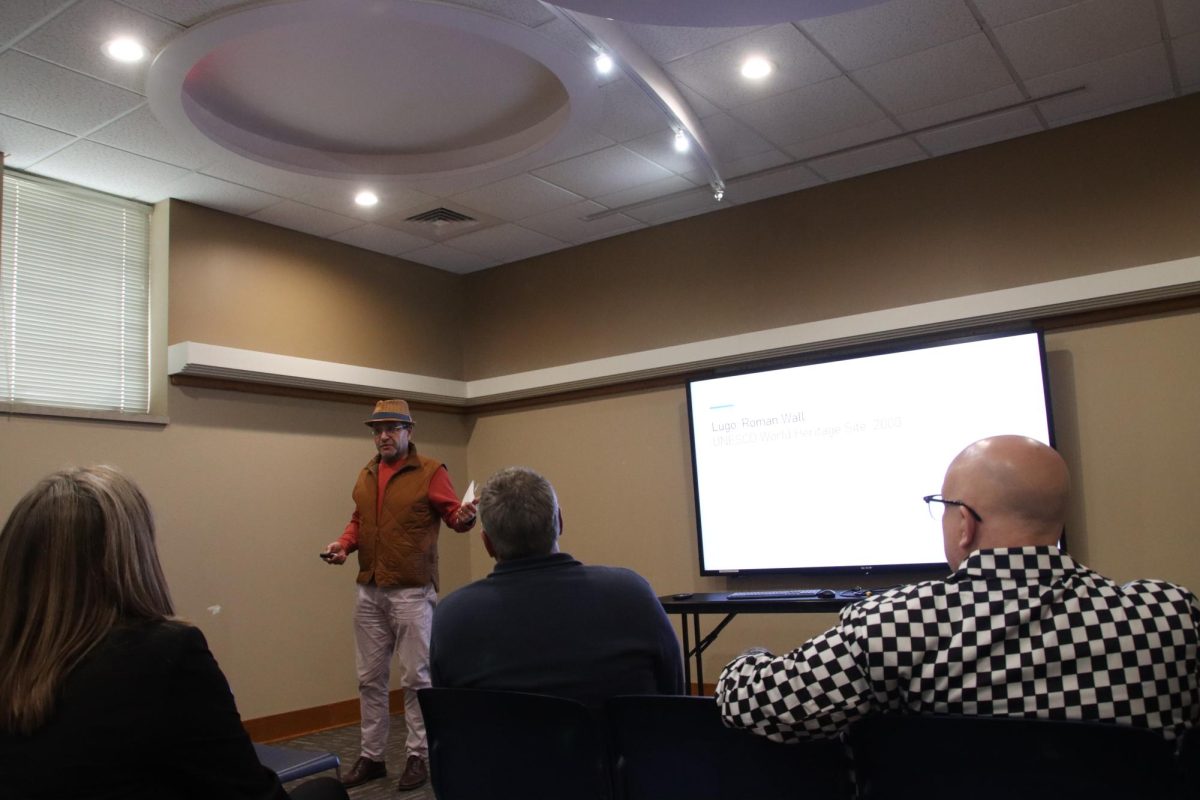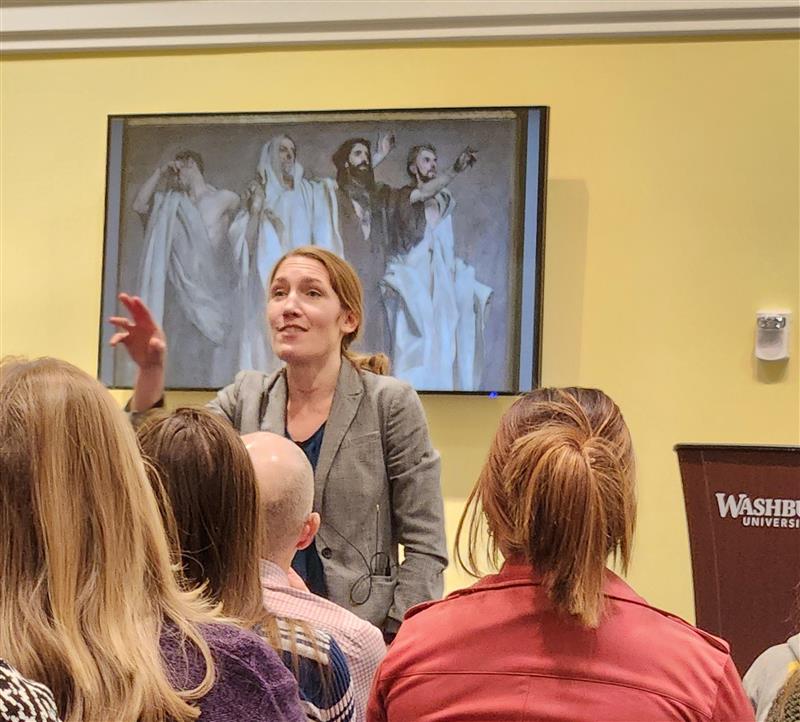
Washburn University held a Thomas L. King religious studies lecture in the Bradbury Thomson Alumni Center on Feb. 24 at 7 p.m. titled, “The Disappointing Prophet: What the book of Haggai can tell us about how we read.” The event was put on by Chris Jones, associate professor of religious and philosophy studies, and featured Laura Carlson Hasler, Indiana University’s assistant professor of religious and Jewish studies, as a guest speaker.
“To be able to bring in, I’m the only religious studies teacher here at Washburn and to be able to bring in people from other universities who have expertise that I don’t have to be able to speak to us, is just incredible,” Jones said. “I love it so much and I’m so grateful to the donors who’ve made this possible.”
Hasler explained that she was originally interested in becoming a Chaplain but became interested in religious studies.
Hasler displayed presentations throughout the lecture, which broke down passages, definitions and English Scholar’s impressions of the prophet’s work. The prophet Haggai wrote the Book of Haggai, which displayed a short collection of prophecies, where his perceived predictions were false and didn’t come to light.
“All that to say is if we had to sum up a given biblical prophets primary emotions in two words, they would be unlike their parents, angry and disappointed,” Hasler said. “I want to talk about what happens when the biblical proverbs disappoint us. I want to explore what that disappointment might tell us about us as readers and to see if there’s any way to find our way out of the fog into a place where we can experience these texts.”
Hasler depicted three stories of Haggai’s throughout the lecture. One about who Haggai was 2600 years ago. Another was about late 19th century scholars who viewed Haggai’s work as discipline and were disappointed with what they came to read as they viewed his works that seemed not to be what was expected of biblical prophets.
Lastly, the third and final story would invite listeners of the event into an exploration of one’s own expectations, after hearing about Haggai’s historical disappointments.
The Book of Haggai originates in 520 B.C., after Jerusalem had been destroyed and its citizens were either killed off or exiled.
In the end of the Book of Haggai verses 2:20-23 Haggai says “speak to Zerubbabel, the governor of Judas. I am going to shake the heavens and the earth. I will overturn the thrones of kingdoms and destroy the might of the kingdoms of the nations. I will overturn chariots and their drivers, horses and the riders, shall fall, each by the sword of his fellow. On that day, declares Yahweh hosts. I will take you my servant Zerubbabel, son of Shealtiel, declares Yahweh. I will make you as signet, for I have chosen you.”
Many Washburn students were present for the lecture, whether they were philosophy students attending the lecture for credit or because of their interest and curiosity in the topic. Kira Roth, junior philosophy major and Kendall Brungardt, English and mass media major, both attended the event.
“I studied all different sorts of movies and TV, books and things that we consume and the idea of affordances is not something that I’ve been able to think about so far,” Brungardt said. “And so I think it’s just a great word to describe how we put meaning to things. And so I’m going to be thinking about that for a long time. And just also prophecies, I just hadn’t really ever thought that hey sometimes they don’t come true, but yeah, it’s interesting.”
Putting events like this together helps influence both groups of students interested in the philosophy and religion departments as listening to the lectures can help provide a new and enlightening perspective for students.
“I also like to think a lot about the interpretations of things,” Roth said. “A huge part of my major is just reading a bunch of really old opinions. And so it’s always refreshing to hear, like a text that we think of as solidified, like the Bible and hear a different perspective on it, because, like some other folks in the audience said and raised questions about, there are so many different interpretations of things and our interpretations versus the different interpretations that are accessible for us to read, can really change our perspectives. And I thought that it was great to hear a different perspective on something that probably was just written off as something that wasn’t accurate. So it was great to kind of get a different insight.”
Thomas L. King lectures are free and open to the public and are held every spring semester. Students can visit the series’ website for more information including a list of previous speakers and a form to receive updates on upcoming lecture events.
Edited by Bidhya Sapkota and Anushma Dahal