-
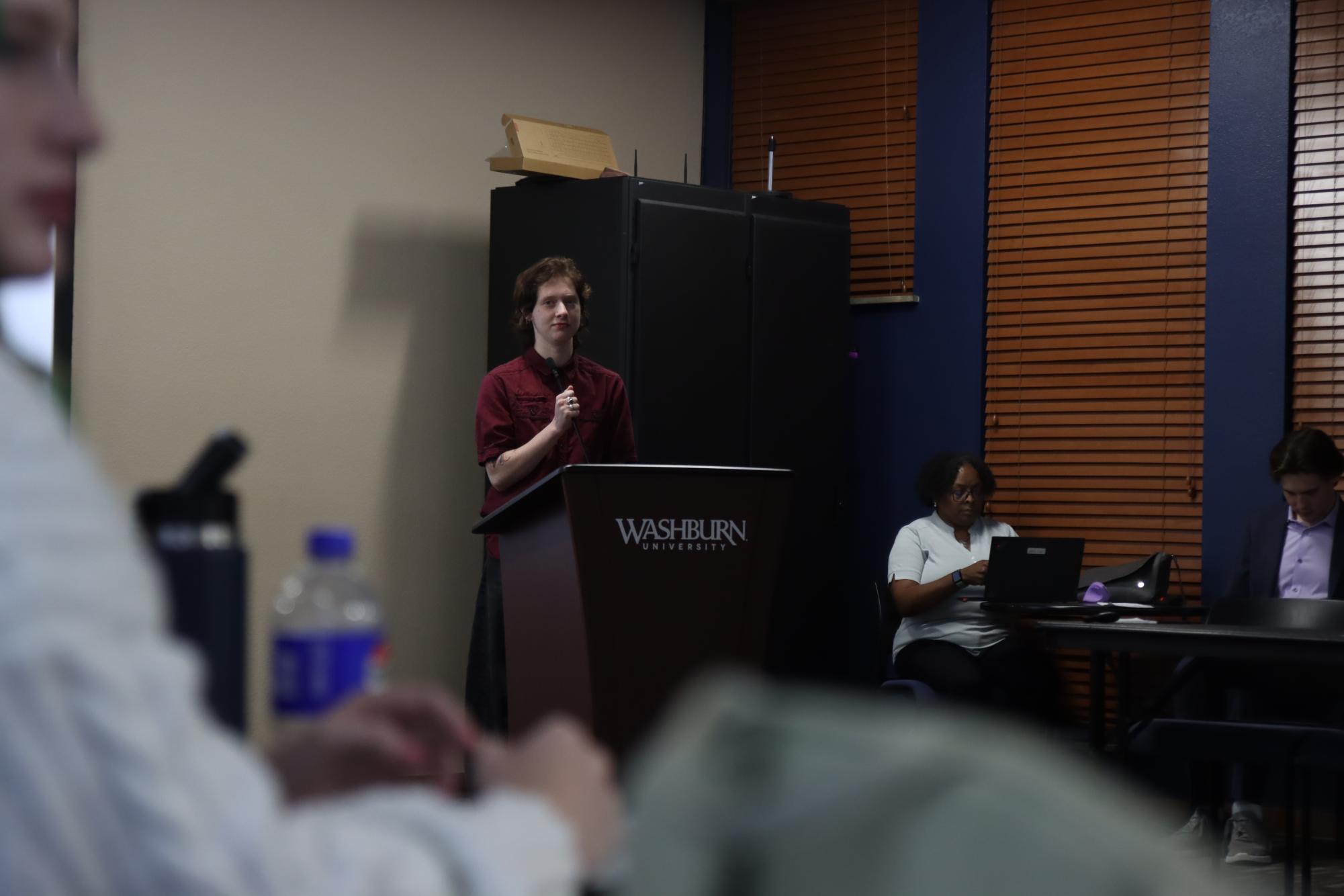
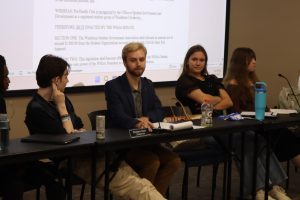
Parker Whaley, chairperson of the then DEI Committee, stands to discuss Senate Bill #65. Senate Bill #65 was passed by the Senate, renaming all references to “Diversity, Equity and Inclusion” to “Student Accessibility and Belonging.”
-
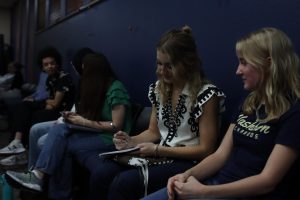
Student organization representatives, upon hearing the agenda, begin to write testimony to hand off to their friends on the senate. Many of the representatives had other commitments that night, making staying to speak on their requests undesirable.

-
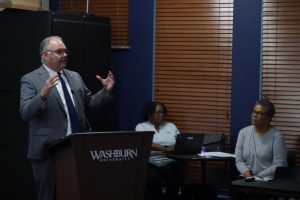
John Fritch, the Provost, spoke on campus moves, AI and other issues. The Provost has traditionally attended at least one senate meeting a year to present to the body.

-
Michelle Godinet, the Equal Opportunity Director, presented to the Senate on her work. Similarly to the Provost, the Equal Opportunity Director traditionally visits a senate meeting once a year.

-
Senator Nick Lloyd finishes speaking on behalf of several student organizations whose representatives had to leave early. The Senate approved every funding request that came before it in this meeting.

-
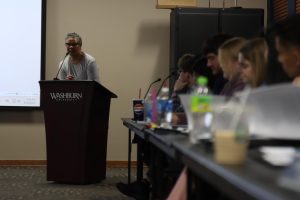
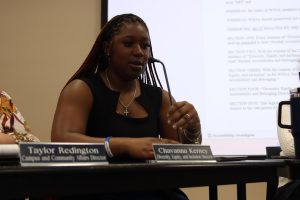
Chavanna Kerney, Director of Diversity, Equity and Inclusion, speaks on Senate Bill #65. WSGA had many internal conversations before the legislation was proposed and presented a united front from everyone in the institution’s DEI infrastructure.

-
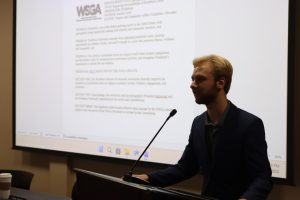
Senator Lloyd speaks on his legislation to try to bring pickleball courts to campus. The legislation passed and will now be presented to President JuliAnn Mazachek.


The Student Senate met last Wednesday Sept. 24 for the longest meeting of the semester. A variety of talks were held, funding requests approved and actions taken as the clocks crept towards 9 p.m., including the rebranding of WSGA’s DEI infrastructure and a resolution supporting pickleball courts. Here are the highlights.
Reports were sparse on much besides updates to work being done, though Kate Coulter, President of WSGA, reminded the Senate of the upcoming Bods Banquet.
Bods Banquet is a recent innovation on the ‘President’s Roundtable’ events WSGA used to put on at least once a semester. The original intent was to provide a direct line of communication from WSGA to student organizations on campus, though previous administrations used the event for other purposes, such as connecting student organizations to President JuliAnn Mazachek.
The current iteration is more focused on building a line of communication from student organizations to WSGA and will occur on Sept.30. Student organization leaders have received email invitations and at time of writing the Coulter/Durst administration intends this Bods Banquet to be the only one of the semester.
Public Forums were held next for John Fritch, the Provost and Vice President of Academic Affairs. The Provost is in charge of the academic wing of the university and as such Fritch’s presentation to the Senate focused on the work that’s been done to ensure teaching continues with the moves around campus. Fritch also discussed artificial intelligence and higher education, stating that there were committees established to look into the issue and what it means for Washburn University.
The next presenter was Michelle Godinet, the Equal Opportunity Director and the Title IX and ADA Coordinator. Godinet presented to the Senate on her work, making it clear that she works at Washburn to be a resource for students who have been discriminated against, harassed or sexually harassed.
Funding requests were then discussed, with a total of 14 different pieces of legislation for the senate to work through. In several instances, student organization representatives left written speeches for their connections on the senate to read so they could leave for other commitments. There is a rule in the WSGA Funding Policy that prohibits senators from representing student organizations, but the potential loophole wasn’t challenged.
After funding requests were approved, several more pieces of legislation were proposed. Firstly, Senate Bill #65 was proposed by the Coulter/Durst administration to change all references of ‘Diversity, Equity and Inclusion’ in all WSGA governing documents to ‘Student Accessibility and Belonging.’ The legislation had support from both Chavanna Kerney, the then Diversity, Equity and Inclusion Director and Parker Whaley, Chairperson of the then Diversity, Equity and Inclusion Committee.
The impetus for the change, according to Ryan Durst, Vice President of WSGA, was that the request to consider the name change came from Eric Grospitch, Vice President for Student Life. Conversations were then held within WSGA, resulting in the legislation. While the impetus was from Grospitch, Vice President Durst made clear that it was a WSGA decision, saying “he just encouraged us to look into it, but it was our decision. We wanted to make sure we spoke to Chairperson Whaley and Director Kerney and keep them in the loop, as well as the entire DEI Committee, before we moved.”
The resolution passed with near-unanimous support from the Senate.
The second piece of legislation considered was Senate Resolution #1, which, upon approval, would make the desire to add pickleball courts to campus an official WSGA position. Senator Nick Lloyd, who also serves as president of the pickle ball club, sponsored the resolution, arguing that, “pickleball is one of the fastest growing sports. It’s successful, affordable, easy to pick up and obviously we don’t have courts here right now. I think it would be good for campus vibrancy.”
Some senators raised objections, citing lack of plans past the resolution for enacting the policy, or arguing that the Student Recreation & Wellness Center (SRWC) had sufficient space for pickleball and that there were courts at the nearby Ichabod Grille. Other senators, including Senator Lloyd, countered with arguments about some of that work being the job of the Washburn administration, rejecting the claim that the SRWC had the capacity and arguing that the Ichabod Grille wasn’t on campus and thus doesn’t fit the needs of the students.
The resolution passed with overwhelming support from the Senate.
The final resolution, Senate Resolution #2, recognized Suicide Prevention Awareness Month. Several edits were needed to correct some grammatical errors with the resolution, but it passed without difficulty.
Following that, there was no new business between the body and adjournment besides the closing roll call. A senator made a motion for a silent roll call due to the lateness of the meeting, which was approved overwhelmingly through a voice vote.
Edited by Anushma Dahal and Stuti Khadka