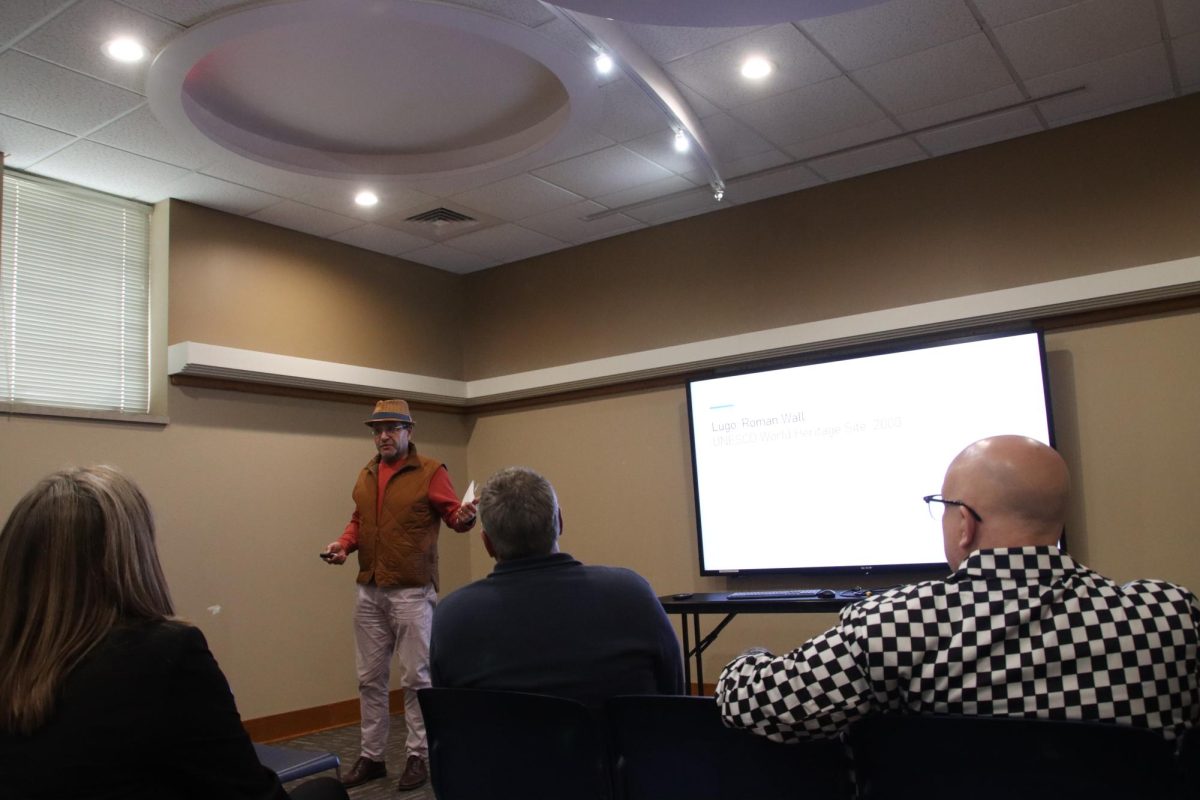
On Wednesday, May 6, an international brown bag lecture was held at Shawnee Room of the Memorial Union. Around 15 people attended the lecture presented by Miguel Gonzalez-Abellas, professor and chair of modern languages.
In the beginning of the presentation, Danny Wade, associate provost for faculty development and student issues and professor of English, welcomed attendees to the lecture and introduced what Gonzalez-Abellas would be presenting during the event.
Gonzalez-Abellas began by thanking everyone for attending his lecture and explained that he would be using many photographs of Northern Spain to illustrate his presentation. He said he had traveled through several major cities, including Madrid, Barcelona, Valencia and Alicante along the Mediterranean coast, with a particular focus on Barcelona and its Gaudí architecture.
Gonzalez-Abellas also noted that Lugo was an important city during the Roman takeover of the northwestern Iberian Peninsula, and that in the third century the Romans built a defensive wall there to protect the settlement from external threats.
“So it’s actually a pretty wonderful one,” Gonzalez-Abellas said. “… With the rains, this last fall, there was a part of the wall that crumbled, and they had to rebuild it. But the problem is that this is a UNESCO World Heritage Site, so they cannot actually rebuild to 20% of your standard status. So we need to keep rebuilding it the way it was, which means that when we have another rainfall may or may not be a part of the wall that collapses again, but you know, there’s a price to pay for being a World Heritage Site.”
Gonzalez-Abellas discussed the evolution of architecture from the Roman wall built in the third century to later medieval structures, including a 13th-century cathedral in Lugo, pointing out its unusual urban setting without a central plaza and even a roadway running beneath its staircase. He also highlighted the mix of sacred and everyday life in the city’s main square, as well as the architectural contrast between older religious structures and 19th-century civic buildings like the City Hall.
Corey Zwikstra, associate professor and chair of English, explained what students can learn from lectures like this.
“I think it depends on the individual presentations,” Zwikstra said. “People go lots of different places, and so not all of the presentations of faculties present are the same…I think, for instance, a lot of folks think of the positives of tourism, ‘Oh, we get to go here. We get to see this. I can take my picture in front of the Mona Lisa or whatever.’ But there is, as Miguel said, a dark side to tourism, that it’s not all good all the time for everybody there. So I think that kind of critical lens is also a benefit.”
Zwikstra also shared what he found most interesting from this presentation.
“I like sort of ancient history, and I didn’t realize what he sort of started with about that continuous Roman wall,” Zwikstra said. “I didn’t realize that that was true, that this was the only sort of enclosed Roman wall that’s still standing so I liked that bit.”
At the end of the lecture, Gonzalez-Abellas described how the Spanish government is introducing measures to regulate tourist apartments such as Airbnb, including restrictions within residential buildings and allowing them only under certain conditions or in dedicated buildings. He also mentioned efforts to limit foreign investment funds from buying properties in city centers, noting that these issues are complex and difficult to resolve.
The lecture ended with a Q&A session. This was the last lecture for the Spring 2026 semester.
Edited by Stuti Khadka