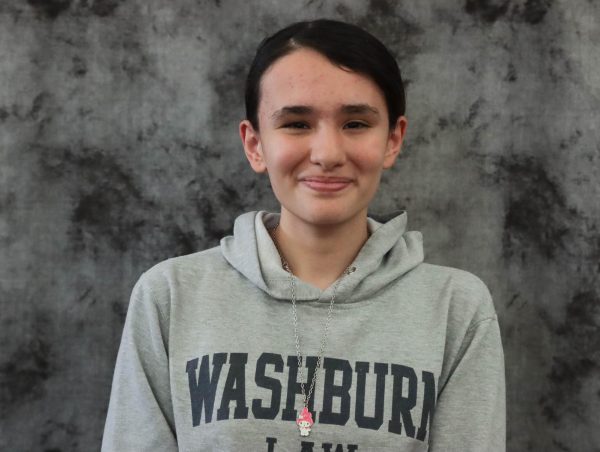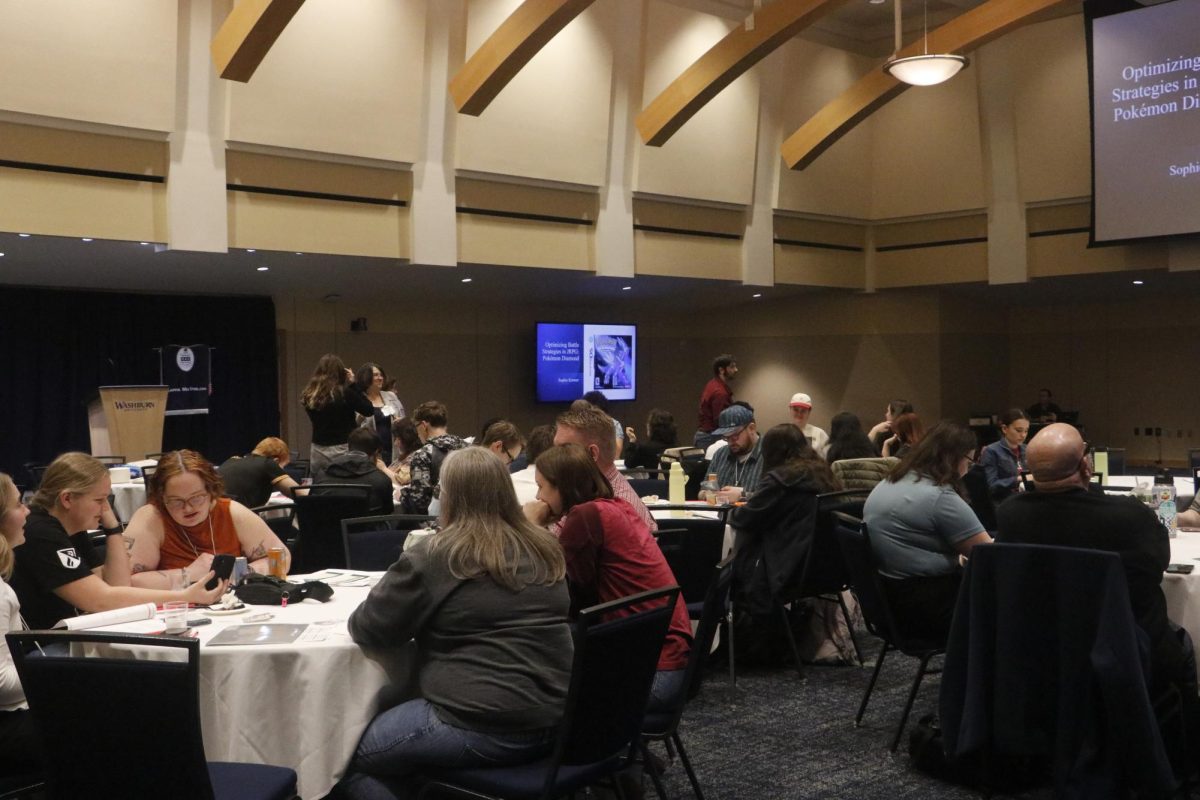
Washburn University hosted the 2026 annual Kappa Mu Epsilon convention, a conference centered on student research presenting on mathematics and statistics topics, for majoring students on April 4. The convention held the likes of members from the program’s very own honor society chapter, Kappa Mu Epsilon, along with the support of WSGA.
The event organizer Sarah Cook, associate professor and department chair of mathematics and statistics, is a proud member of the organization, as well as having previously won an award for presenting at KME in the past.
“The Kappa Mu Epsilon organization, or we call it KME, it’s just been a big part of my math journey,” Cook said. “I did a national trip with a group of students when I was a junior in college, and then I presented as a senior, and then I’ve been involved here with overseeing some research projects and now organizing the conversation and it’s just a wonderful organization for our students.”
Cook’s role as event organizer included setting everything up that was necessary, communicating with other schools, setting up registration pages and helping with scheduling.
Six student presentations were held from Washburn University, Truman State University, Evangel University and Pittsburg State University.
- “The Structure of Linear Extensions of Partially Ordered Sets” by Clarice Andorno.
- “Transcendence/Irrationality through Modular Congruence” by Mohammad Asfaque.
- “Make Factoring Make Sense: Why the Order of Factoring Strategies Matters” by Chandelyn Buckner.
- “Square Sum Graphs and Functional Binary Generalizations” by Seth Loudermilk.
- “Analytical Solutions for the Singlet-Triplet Energy Gap for Two Interacting Spin 1/2 Particles” by Kaitlyn Standefer.
- “Optimal Battle Strategies in Pokemon JRPG” by Sophie Kramer.
Buckner’s presentation explained how the order of factoring strategies matters in algebra instruction, with a focus on the ethics of mathematical education and how it impacts students’ knowledge and understanding. She emphasized the struggles students face when it comes to factoring, due to poor sequencing procedures lacking meaning.
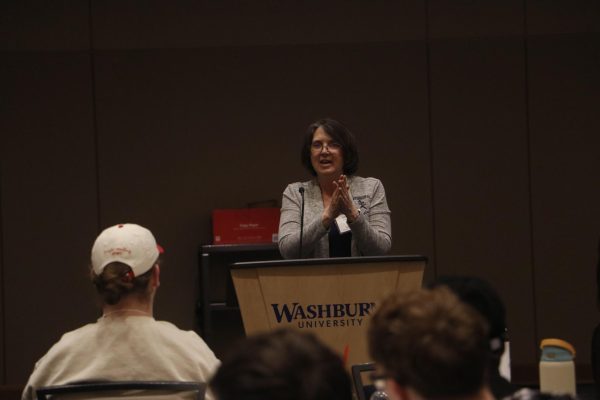
Buckner held the perspective of self-improvement from teachers when explaining factoring to students by teaching how symbolic and visual methods relate to each other in terms of solving a problem, in order to solve procedural errors.
“Correct answers do not always mean real,” Buckner said. “Understanding these struggles that students experience can be resolved when we focus on the order in which we teach these factoring strategies.”
Buckner’s key ideas from her presentation were embedded in the fact that factoring isn’t about finding numbers, but understanding structure can result in there being more correct answers from students, when they are able to fully understand the process it takes to solve factoring problems and how they came to their conclusion.
“I think that having that background [KME participant], and understanding will allow me when I help my students, when they’re making mistakes, having excelled in math will allow me to be able to see where those mistakes are coming from, so I can look at their work and be like “Okay, so I think that we’ve done this, but this is what we need to fix to be able to get the right answer,’” Buckner said. “That’s a big thing that they teach us in math education is going back and looking at our students’ work and figuring out where things went wrong. And I think just having that background in mathematics really allowed me to be able to efficiently catch those mistakes before they become a habit.”
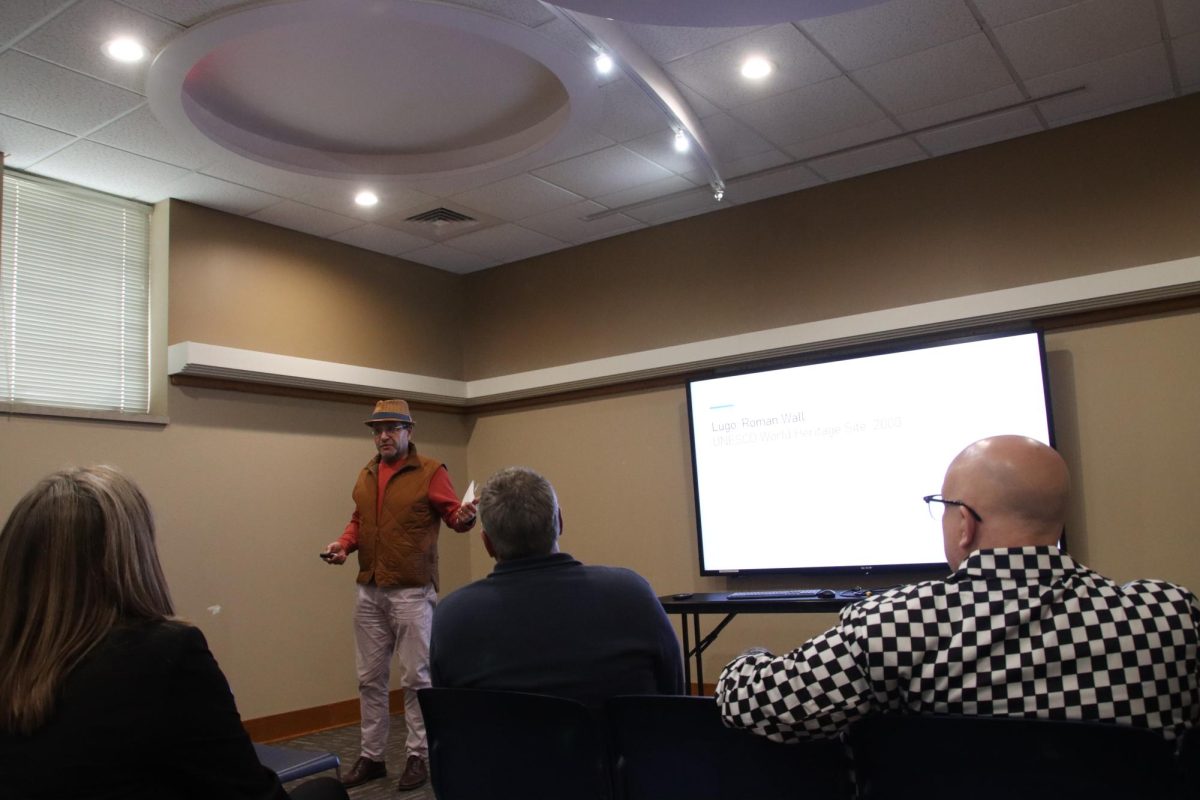
Asfaque’s presentation on transcendence and irrationality through modern congruence. Asfaque became interested in the idea of this because of his interest in adding digits together to form a single digit, and forming the question, how do you define an infinite number? He wanted to explore the idea of further reducing single digits.
“So if you have A to the power B, where A is not a square of 1 but is not a great number, and if your B is a great number, but not rational,” Asfaque said. “So if rational is a great number, then A to the power B is transcendent. This [theorem] helps us define consistently modular reduction for monomial towers. Monomial towers are basically a finite tower of rational numbers stacked on top of each other.”
Washburn University has helped students like Asfaque and other presenters for KME to help prepare for their presentations and get all the support they need by providing them with the proper tools and resources to expand their research.
“If it was not for Washburn, I don’t think this was possible,” Asfaque said. “Because at other universities, … bigger universities, they give you the topics you should work on, but Washburn, being a small university, I felt like I was given the independence. They let me just explore what I wanted. And my advisor, she was very helpful. She would look at my documents every week and poke holes in it, and my math department was funding me to go to other conferences. So overall, very supportive.”
The mathematics and statistics department and KME honor society were honored to be able to put on such a successful event and look forward to the next KME conference, as well as continuing to support students grow in their future careers and goals.
Edited by Stuti Khadka, Anushma Dahal and Bidhya Sapkota